
Finding Your Path
The Quiet Before the Boom: Why 2026 May Be a Defining Moment for Multifamily
By Lorne Polger, Senior Managing Director
 There’s a particular kind of opportunity that hides in plain sight – one that arrives not with fanfare, but with the slow grind of forces that have been building for years. The 2026 multifamily real estate market is auxh a moment.
After enduring one of the more turbulent real estate cycles in recent memory – a pandemic-era construction frenzy, historic interest rate hikes, and a new supply wave that hasn’t been seen since the 1970s – the multifamily sector is approaching something rare: a structural realignment where the stars are aligning for disciplined, forward-looking investors.
The Supply Story is Flipping
The most compelling part of the bull case isn’t speculative – it’s math.
Between 2023 and 2025, developers delivered one of the largest waves of new apartment units in recent history. In markets like Austin, Nashville, and Phoenix, inventory swelled by close to 20% in just three years. Vacancy rates climbed, rent concessions rose, and investors who bought at peak valuations found themselves in difficult situations.
But here’s what matters now: new construction has declined in a meaningful way. In 2024, developers broke ground on 335,000 units, down sharply from the peak of 531,000 just two years earlier. While the number rose slightly in 2025, it is expected to fall substantially in 2026-2028. According to the National Association of Home Builders, new multifamily starts over the next few years are expected to hover in the mid-300,000 range – 40% below the 650,000 units delivered in 2024.
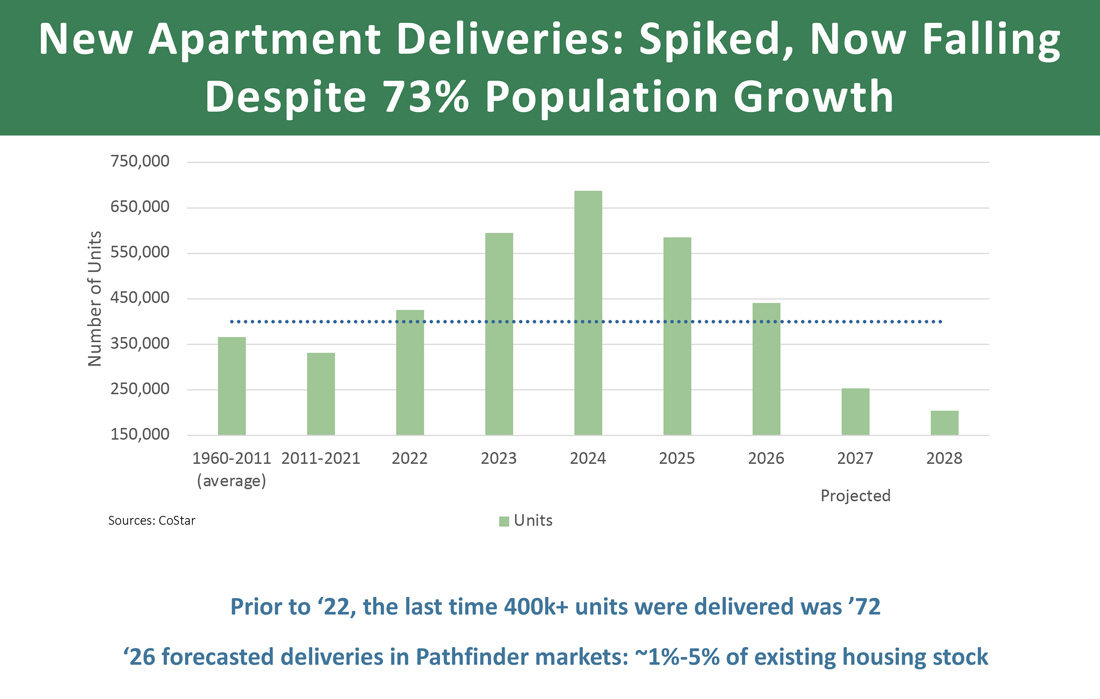
We hit a short-term oversupply blip (especially in the Class-A space), and it had a significant impact on rents, net operating income and valuations. But the markets are wise. Generally, when new construction doesn’t pencil, developers don’t develop and lenders don’t lend. The pipeline, the single biggest headwind for investors, has been draining fast.
Demand Never Actually Declined
While headlines focused on rising vacancies and softening rents, little was mentioned about the ongoing (and in some cities, rising) demand for apartments.
Over 350,000 new units were absorbed in 2025, the third highest total in 25 years. Renters are filling new units now almost as fast as they are being delivered. According to CBRE, net absorption totaled 78,100 units in the first quarter of 2026. More than 90% of the markets tracked by CBRE (63 of 69 markets) recorded positive net absorption in the first quarter.
In 2025, the median age of first-time homebuyers reached 40, the highest age on record, underscoring the long-term shift toward delayed homeownership driven by elevated mortgage rates, high home prices, and limited affordability. With the average newly originated mortgage payment 35% higher than the average apartment rent, millions of would-be buyers are remaining renters for far longer than previous generations. That’s not a temporary blip but a structural shift that underpins multifamily demand for years to come.
The Rate Environment Is Finally Cooperating
From 2023-2025, rising interest rates squeezed the life out of multifamily transactions. Investments that penciled at 3% borrowing costs no longer worked at near double that. Sellers held. Buyers retreated. Volume cratered. Pathfinder sat on the sidelines.
 That environment began changing about 20 months ago. After three consecutive 25-basis-point reductions in late 2025, the federal funds rate now stands at 3.50% to 3.75%, with markets wavering on whether we will see one more interest rate reduction this year. Multifamily borrowing rates from the agencies (Fannie Mae and Freddie Mac) can still be had in the low 5% range (with a rate buydown ). In our most recent acquisition, we obtained a five-year loan from Fannie Mae at 4.82%.
And the markets are taking note. Total multifamily originations are projected to reach approximately $400 billion in 2026, a 20% increase over 2025.
Lower rates are starting to bring investors and capital providers back. The question is whether you are positioned before the crowd arrives.
The Distress Window Is Open for Now
Approximately $162 billion in multifamily loans are scheduled to mature in 2026, a 56% increase from the prior year, with an estimated 60% of apartment loans originated during the 2021–2022 vintage expected to come due in the second half of 2026. For borrowers who financed at low rates and now face refinancing in a significantly higher rate environment, the math is unforgiving.
This is creating a wave of motivated sellers – owners who are unable to hold, refinance, or recapitalize without taking a loss. For buyers with ready access to capital and operational expertise, properties currently underwater for their owners due to overleverage (and not their physical and operational characteristics), are likely to present buying opportunities. That’s where Pathfinder is primarily hunting.
Historically, these windows don’t stay open long; we’ve seen how this plays out before. Once rates stabilize further and the worst of the maturity wall clears, values are likely to rise and distressed deals will evaporate.
Where the Smart Money Is Moving
Institutional capital is making its way back into multifamily, with many large investors adjusting their buy boxes and deploying capital into what they see as more rationally priced assets – stabilized and well-located properties where future rent growth is more likely.
The return of institutional buyers is significant. These are not sentimental actors; they are deploying billions based on rigorous underwriting. Their re-entry is a signal that the risk-reward profile of multifamily has improved.
For sub-institutional groups like Pathfinder (we fly below the radar of the largest institutions, targeting properties too small to attract their interest), the window is now – before institutional capital fully reprices the market. We believe that high-growth markets like Phoenix, Salt Lake City, and Denver will see considerable value creation over the next several years, driven by superior renter demand and reduced construction pipelines, leading to accelerated rent growth.
The Case for Acting Now
This is not a call to speculate. The risks are real. Tariffs and geopolitical uncertainty, weakening consumer financial health, a new Federal Reserve chair and the possibility of stagflation all present genuine headwinds. Markets that were oversupplied may take longer to recover.
But the fundamental thesis is sound: for investors focused on stability, resiliency, and wealth compounding over time, 2026 does not represent the end of a challenging cycle – it marks the beginning of the next one.
The plummeting supply of new units is real. Demand for apartments remains strong as young people continue to delay (or forego) the purchase of that first home. Capital is returning. And the distressed deals that define the best vintages of any cycle are making their appearance now (we saw this as investors in the early 1990s and the early 2010s and see it again today).
Investors who look back on this period with satisfaction will not be the ones who wait for certainty. They will be the ones who recognize that certainty, when it arrives, has already been priced in.
We have all learned pearls of wisdom from sage investors over the years. One of my favorites comes from Warren Buffett. “If you wait for the robins, spring will be over.”
Lorne Polger is Senior Managing Director of Pathfinder Partners. Prior to co-founding Pathfinder in 2006, Lorne was a partner with a leading San Diego law firm, where he headed the Real Estate, Land Use and Environmental Law group. He can be reached at lpolger@pathfinderfunds.com.
Share this Article

IN THIS ISSUE
CHARTING THE COURSE
The Magnitude of Small Changes, Compounded
FINDING YOUR PATH
The Quiet Before the Boom: Why 2026 May Be a Defining Moment for Multifamily
GUEST FEATURE
Like a Message in a Bottle: Investing in an Uncertain Future
ZEITGEIST
News Highlights
TRAILBLAZING
The Fletcher Apartments, La Mesa (San Diego), CA
NOTABLES AND QUOTABLES
Character