
Charting the Course
Looking Ahead to 2031: Demographic Shifts, Likely Economic Scenarios Bullish for Multifamily Investing
By Mitch Siegler, Senior Managing Director
 While the next five years could make the demographic changes and economic turbulence we’ve experienced since the pandemic look like the warm-up act, multifamily investors should take heart as many high probability scenarios ought to be constructive for apartment investing.
Already, demographics are shifting in ways that significantly impact demand for housing. Federal budget deficits, already in nosebleed territory, are worsening. (The Treasury Department announced in July that the budget deficit hit $1.4 trillion for the first nine months of fiscal 2026, a $1.9 trillion annualized level). If that weren’t enough, artificial intelligence (AI) is changing hiring and employment in unprecedented ways, and its adoption is accelerating at breathtaking speed.
The multifamily construction pipeline, which ballooned in 2021-2022 and led to a wave of new apartment deliveries since 2024, has been shrinking rapidly, setting the stage for undersupply for the next few years. Only developers with the strongest stomachs will take on 7%+ construction loans in an uncertain environment. And real estate firm JLL’s July 13 report, which flagged construction cost increases of 5% for the first half of 2026 (and the possibility that these could hit 8% by year-end) is another nail in the coffin for new development. And, while we’d love the Federal Reserve to reduce rates, today’s (or higher) interest rates are likely here to stay for a while.
Our investors trust us to deploy capital in a disciplined fashion by acquiring and improving apartments in markets we know well. Before deploying capital, we analyze a property thoroughly, stress-test our assumptions with sensitivity analysis and seek to anticipate potential changes in markets. That process is less about predicting the future and more about developing scenarios with reasonable likelihoods of coming to pass.
The scenarios below are intended to help us think strategically about our business and portfolio over the next five years. They are based on demographic and economic factors, but not potential regulatory changes, since these vary greatly by locality.
 First, we unpack likely demographic shifts, essentially baked in the cake today. Then, we offer several high-probability economic scenarios. While the economic scenarios lead in slightly different directions, all roads should lead to destinations constructive for multifamily investing.
Demographic Changes Ahead. (Remember: The Die is Already Cast.)
Forecasting future market performance is different from projecting demographic changes in five years: The former requires extensive fundamental and financial analysis and a bit of conjecture. The latter is basic math – bringing today’s data forward to tomorrow.
The headline is that our population, 342 million, will barely grow – to 352 million in 2031, according to U.S. Census Bureau estimates. That sluggish growth rate, about half of what we’ve grown accustomed to, is because fertility levels – just 1.57 children per woman, per The Wall Street Journal – remain well below replacement rates and immigration has slowed to a crawl. Even massive shifts in birthrates or immigration – unlikely, to say the least – won’t meaningfully change the population in 2031.There will be winners and losers, of course – some cities will grow as others shrink but U.S. population growth in the next five years will be largely a zero-sum game.
The story gets more interesting when you peel back the onion. By 2031, the entire Baby Boomer generation – 73 million – will be 67 to 85, meaning all Boomers will be of retirement age. In five years, Boomers will comprise 23% of the population, more than a one-third larger share of the population than a decade earlier (17% in 2022), according to the Census Bureau.
In 2031, the primary renter cohort, those 25 to 34, will shrink modestly. But this will be swamped by three countervailing forces which should turbocharge apartment demand. First, Millennials (31 to 45 today), who have increasingly been delaying homeownership and choosing to rent apartments, will continue to do so, especially with today’s 6-7% mortgage rates. Second, many in the Gen Z cohort will finally leave their parents’ homes and launch households of their own. And third, the Boomer downsizing wave will hit full stride by 2031, and many Boomers will vacate their homes (primarily for financial or health reasons). Most will move to rental communities (both traditional apartments and senior housing communities) to save money, reduce maintenance or for more amenities. It’s ironic: Boomers told their kids for decades that renting was throwing money away yet by 2031, many will be renters.
Economic Scenario #1: Extended Soft Landing
In our first 2031 scenario, the Federal Reserve’s soft landing, brought about by aggressive interest rate hikes in 2021-2022, has held – sort of. Inflation in the next five years will run hotter than the Fed’s 2.0% target, probably in the range of 2.5-3.0%. Markets adjust, accepting higher inflation as the new normal. Economic (GDP) growth has been tepid, ranging from 1.8–2.4% annually since 2026, sustained by government spending, AI-driven productivity gains, and consumer spending on services and experiences. Not a recession but the economic equivalent of a treadmill at 2 mph.
 Federal deficits have remained elevated, at $1.5-2.0 trillion annually. We’ve sustained high deficit spending because the U.S. dollar has remained the world’s reserve currency and Treasury auctions continued to be successful. By 2031, the U.S. federal debt-to-GDP ratio could hit 115-120% (up from about 102% or $31.7 trillion now), according to estimates by J.P. Morgan Asset Management. The bond market will continue to absorb the increased debt, and the 10-year Treasury will remain in a stable range of 4.5-5.0%.
AI will, of course, disrupt labor markets. Boston Consulting Group forecasts that AI automation will eliminate (or dramatically change) up to one in seven white-collar positions (think customer service and back-office roles) by 2031. (On the bright side, the other six office workers will be busy, among other things writing AI prompts.) New job categories – those requiring physical presence, human judgment, or specialized (trade) skills – offset many of these job losses, enabling the unemployment rate to remain in the 5.0-5.5% range. Demand for and wage growth for skilled and trade workers will remain strong. Less so for entry-level office workers.
The 2031 environment for apartment investors and operators is more favorable than the prior decade. Few projects started after 2024 (because of elevated interest rates and construction costs) and delivery slowed significantly after 2027, creating tight supply. This generates 3-5% annual rent growth from 2028-2031. The 2031 apartment market benefits from this undersupply and from the strong demand for housing because of demographic drivers – Millennials continuing to rent and Boomers downsizing, many into apartments. (As reported by Newsweek in June 2025, Point2Homes’ U.S. Census data analysis found that the number of renters over the age of 65 increased by 2.4 million, nearly 30%, between 2013 and 2023.)

Economic Scenario #2: Fiscal Fracturing
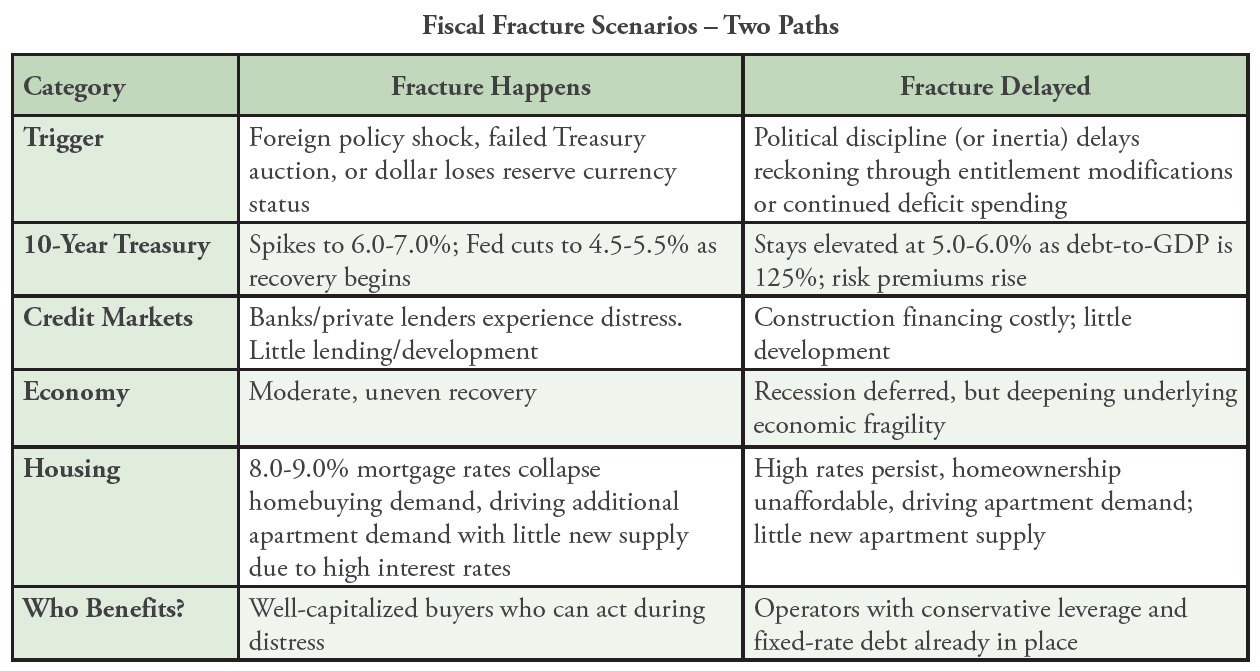
In our second 2031 scenario, the U.S. experiences fiscal fracturing, likely triggered by a foreign policy event, a failed Treasury auction, and/or the dollar’s loss of reserve currency status. Whether this will happen prior to 2031 or not is a variable – we consider both options below. The forces for such a fracturing (financial markets balking at excessive federal debt and high government spending) have been building for decades and will be challenging to avoid.
If such an event happens in the late 2020s, the economy would likely be in recovery by 2031. If not, the federal government will have kicked the can through modifications to spending on entitlement programs (Social Security/Medicare), and we will have narrowly avoided financial disaster – for a bit. In this case, the underlying fiscal imbalances will have only deepened further, leaving the system even more fragile. Either way, in this scenario, the 2031 economic environment will be stressed.
If a fiscal fracture materializes prior to 2031, the 10-year Treasury yield could spike to 6.0-7.0% and banks and private lenders would likely experience significant distress. These factors (higher interest rates and lender distress) would likely lead to a recession. A downturn would probably cause the Fed to cut interest rates aggressively, driving down the 10-year Treasury yield to 4.5-5.5%, starting a new credit cycle.
The spike in Treasury rates would drive mortgage rates to 8.0-9.0% and take the remaining air out of the single-family home market, providing a further tailwind for rental demand. (Keep in mind that demographic shifts mean there’s little single-family homebuyer demand before mortgage rates rise with many Boomers downsizing and Millennials who have been renting continuing to do so.)
Now, if we avoid a fiscal fracture prior to 2031, the underlying federal debt dynamics would likely have worsened. Imagine the bond market’s reaction to a federal debt-to-GDP ratio of 125% or more in 2031; it would likely boost risk premiums for U.S. treasuries, keeping 10-year yields elevated in the 5.0-6.0% range. In this case, construction financing costs would be largely prohibitive crimping new apartment development; the multifamily supply/demand imbalance would be even more acute in this scenario. However, existing property owners with fixed-rate debt would enjoy a moat, protecting them from new competition.
In either version of this fiscal fracturing scenario, disciplined apartment operators with conservative capital structures and fixed-rate debt who own properties in cities with diversified employment and a chronic undersupply of housing should be rewarded. The earlier fracturing would create extraordinary buying opportunities in 2029-2031 while later fracturing would push off the day of reckoning – and generational buying opportunities – for a few years.
Quality Multifamily Operators/Properties Should Benefit in Any Case
As noted above, demographic drivers through 2031 set the stage for high apartment demand and much reduced new supply. In either of our economic scenarios, an essentially flat population, higher fiscal deficits and dislocation to employment from AI are virtually assured. These conditions probably mean muted consumer confidence, contributing to weak homebuying and stronger apartment demand, supporting multifamily investments.
After years of flat capital allocations, the macroenvironment in 2031 is constructive for apartments, which are again a core allocation for institutional investors as a portfolio diversifier and driver of investment returns. Institutions will need alpha in their portfolios in an environment where equity returns are likely much lower than in the prior decade.
By 2031, investment performance will be largely determined by property performance (not cap rate compression), which will be driven by operator quality (evidenced by property selection and operations, capital structures and type and term of debt). Capital will flow to strong operators with reasonable capital structures and away from most everyone else.
This environment plays to the investment philosophy Pathfinder has maintained consistently across cycles: conservative leverage, fixed-rate agency (Fannie Mae and Freddie Mac) debt, thoughtful portfolio construction across resilient and diversified-employment metro areas, and a focus on the value-conscious, workforce housing segment.
We believe our process of stress-testing acquisitions for higher cap rates or lower rent growth environments should pay off during challenging economic environments. This sort of underwriting isn’t glamorous but it sure beats missing the mark and having investments go sideways – or worse.
What this Means for Our Portfolio
This scenario framework is a systematic way of thinking about a range of environments in which we may be operating and deploying capital over the next five years. Markets do have a way of producing “Black Swan” events not on most bingo cards and these “out of left field” outcomes can confound even well-constructed scenario analyses.
What this approach tells us is that a variety of economic and investing scenarios, the case for U.S. multifamily real estate in supply-constrained markets with diversified economies should be stronger in 2031 than in the prior decade. The supply trough is deepening. Demographic demand drivers are broadening with several large renter cohorts – young adults constrained by affordability, the Gen Z generation leaving their parents’ homes and launching in apartments of their own, Millennials who deferred homeownership during their peak buying period, and Boomers selling their homes and downsizing, many in apartments.
The landscape reinforces our continued use of longer-term, fixed-rate debt and the need to continue to stress-test potential acquisitions for “higher for longer” interest rate environments. It also supports our focus on resilient metro areas with diversified employment where workforce apartments offer excellent housing value.
2031 will be here before we know it. We expect the next five years to bring twists and turns that historically come about only every decade or two. As we’ve learned over the past 20 years, our disciplined investment approach leads to resilient investment portfolios which can thrive even in turbulent times.
Note: The information here should not be considered a forecast or investment advice.
Mitch Siegler is Senior Managing Director of Pathfinder Partners. Prior to co-founding Pathfinder in 2006, Mitch founded and served as CEO of several companies and was a partner with an investment banking and venture capital firm. He can be reached at msiegler@pathfinderfunds.com.
Share this Article

IN THIS ISSUE
CHARTING THE COURSE
Looking Ahead to 2031: Demographic Shifts, Likely Economic Scenarios Bullish for Multifamily Investing
FINDING YOUR PATH
The 2026 Midterms: What Real Estate Investors Need to Know
GUEST FEATURE
Technology Isn’t Replacing Accounting and Finance – It's Elevating It
ZEITGEIST
News Highlights
TRAILBLAZING
Cowles Landing, San Carlos (San Diego), CA
NOTABLES AND QUOTABLES
Simplicity