
Guest Feature
Record Apartment Supply and the Positive Impact for Renters
By Scot Eisendrath, Managing Director
 For the last few years, many multifamily conversations have started with supply: record deliveries, which led to higher vacancies, heavy concessions and little to no rent growth. All true. But that singular focus has concealed an important benefit for tenants.
While market rents stalled, the average renter’s income has kept growing. The result is meaningful: among residents signing leases at market-rate apartment properties; the share of income spent on rent has fallen to pre-pandemic levels, making their housing more affordable. That does not mean every renter is doing well, but it does weaken the argument that market-rate renters have never been more stretched or do not have the capacity to pay higher rents.
That matters because there are two conditions for rent growth: a tighter rental market and residents who can afford to pay higher rents. As the current supply wave recedes, healthier rent-to-income ratios should give many property owners more room to raise rents to keep pace with their escalating expenses as supply/demand conditions tighten. The combination of falling supply and improved renter capacity is worth watching.
Wages Have Continued to Rise While Rent Growth Has Stalled
For apartment residents, the rent-to-income ratio peaked in 2021 and has fallen almost every year since. Zooming out, the median rent-to-income ratio is essentially where it was six years ago (as shown in the table below), notwithstanding cumulative inflation of nearly 30% during that time, according to the Bureau of Labor Statistics’ Consumer Price Index data.
| Year | Median Rent-to-Income Ratio |
|---|---|
| 2019 | 22.2% |
| 2020 | 22.0% |
| 2021 (peak) | 23.8% |
| 2022 | 23.2% |
| 2023 | 23.3% |
| 2024 | 22.5% |
| 2025 | 22.0% |
Source: RealPage
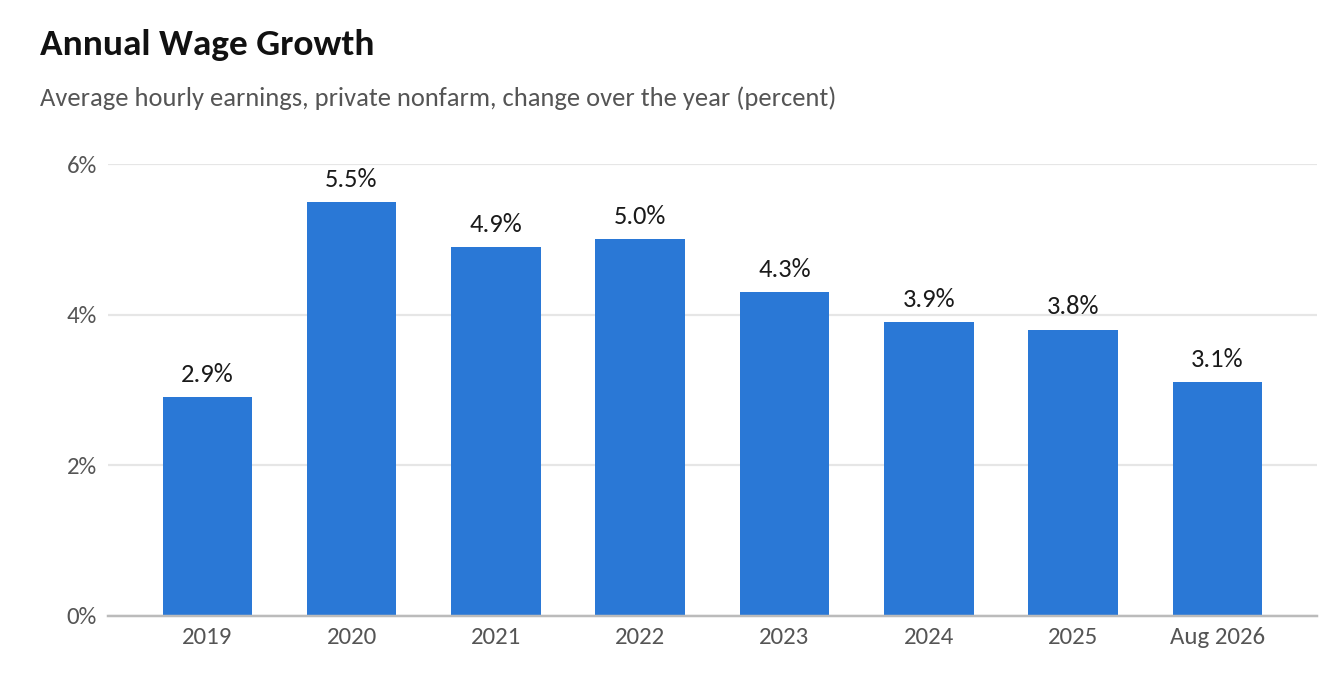
The math is straightforward: rent growth has been tepid while wages kept rising. In fact, wage growth has outpaced rent growth for more than 40 consecutive months, according to a July 2026 Forbes analysis by Brad Hunter (“Rental Demand Remains Strong, Defying Expectations”).
Source: U.S. Bureau of Labor Statistics (BLS)
Average hourly earnings reached $37.75 in August 2026, up roughly a third since December 2019. Meanwhile, the apartment supply wave increased renter choice and put downward pressure on rents. This combination has allowed rent-to-income ratios for market-rate residents to fall, benefiting tenants.
Few Renters Are Buying Homes
Owning a home, the alternative to renting, also remains expensive, which supports tenant retention and resident willingness to absorb rent increases. In March 2026, renting a starter home was cheaper than buying one in all 50 of the largest U.S. metros. The average monthly cost to buy was close to $2,600, or 55% higher than renting across those metros; the median rent was $1,669 (Realtor.com).
New Apartment Delivers Falling Sharply
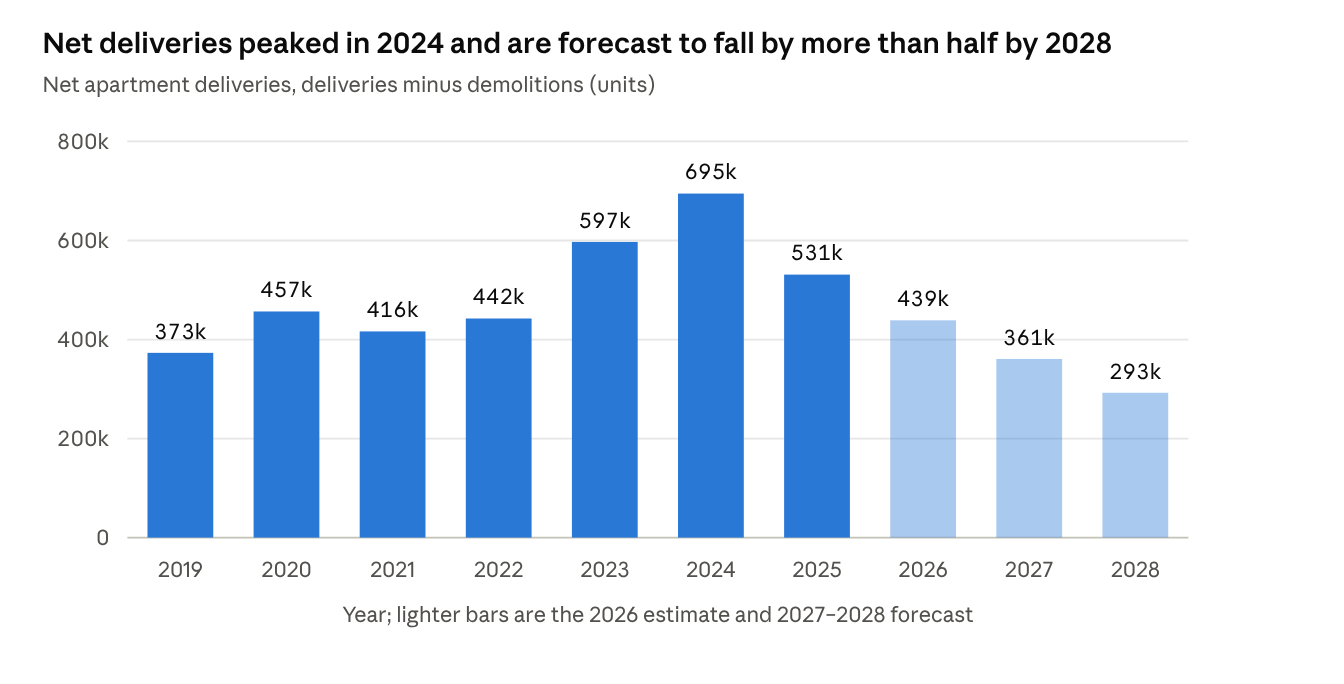
For the past few years, apartment deliveries have made many cities a renter’s market. Property owners – especially those with brand new (empty) buildings offered concessions to fill those units. Now that much of the supply has been absorbed, it’s more of an apartment owner’s market, a trend we expect to accelerate. Net U.S. apartment deliveries peaked at about 695,000 units in 2024. The forecast below is for deliveries to fall to 439,000 in 2026 and to 293,000 in 2028, about 58% below the peak (CoStar).
Source: CoStar
While supply is dropping sharply, demand continues to hold up. Net absorption topped 250,000 units in the first half of 2026, outpacing new supply by about 100,000 units and lifting occupancy to approximately 95%, according to a July 2026 Forbes article. If absorption continues to exceed new apartment deliveries, concessions – which have already fallen considerably – will dry up. After that, we expect rent growth to follow.
What Could Get in the Way?
Rent-to-income ratios are useful, but they are not enough by themselves and can’t be viewed in a vacuum. We’re watching three other factors:
The broader renter population is still stretched. Harvard’s Joint Center for Housing Studies reports that 49% of renter households (22.7 million) spent more than 30% of income on rent and utilities in 2024, the traditional threshold for being considered “housing cost burdened”. Rent-to-income ratios also run notably higher in Class-C (less expensive, older) apartments than in Class-A (more expensive, newer), and Class-B (workforce housing), based on Greg Willett’s June 2026 analysis in Multifamily Executive.
With AI adoption, future income growth is uncertain. A weaker labor market would directly pressure income gains and apartment demand. Slower population growth or weaker household formation could also delay the shift from a renter to a property owner’s market.
Inflation is squeezing household budgets. Rent-to-income captures only one line of the household budget. The national average for gasoline prices hit close to $4.50 per gallon in September, and diesel is above $6.50 per gallon. When rising gas, utilities and grocery prices outpace the growth in worker paychecks, renters have less available for rent, even if their rent-to-income ratio looks healthy.
The Impact on Apartment Investors
For investors, the more useful conclusion is not that every apartment market is poised for rent growth. It is that conditions for future rent growth are continuing to improve, and the opportunities will be greater for particular properties and submarkets. Since not all properties and markets are the same, we remain focused on:
- Underwriting affordability at the submarket and property level. We favor submarkets where rent-to-income ratios are at or below pre-pandemic levels and wage growth is steady. That combination offers the most potential for rent growth.
- Focusing on renters who have the ability to absorb future rent increases. That’s important because inflation seems here to stay and those cost increases need to be offset by higher rents over time. Well-located properties with resident incomes that have kept pace with rents should have more flexibility than properties serving households already under budget pressure.
- Targeting submarkets where the supply dropoff is steepest. The national decline in deliveries is not even across markets. Markets where new supply is falling fastest relative to absorption should see concessions burn off first, and that is where rent growth is likely to appear first and to be strongest.
While many of the headlines about multifamily have focused on the supply wave and its effects on multifamily operations, the deeper story is that renter incomes have had several years to catch up while rents cooled. As supply continues to fall, that improved rent-to-income position should matter. While uncertainty remains, a more balanced market should give owners a better foundation than the headline rent numbers alone would suggest.
Scot Eisendrath is Managing Director of Pathfinder Partners. He oversees the firm’s financial analysis and underwriting and has spent more than 20 years in the commercial real estate industry with leading firms.
Share this Article

IN THIS ISSUE
PATHFINDER PARTNERS GROWTH & INCOME FUND, L.P.
$178,000,000 Recapitalization of Six Apartment Properties
CHARTING THE COURSE
The Pump, the Mortgage Payment, and the Power Bill: How $6.25 Diesel, 7.4% Mortgages and Data Center Backlash Will Shape the Midterms
FINDING YOUR PATH
How Phoenix, Denver, and Austin Got Overbuilt – and Why that Presents Opportunities
GUEST FEATURE
Record Apartment Supply and the Positive Impact for Renters
ZEITGEIST
News Highlights
TRAILBLAZING
The Modern Fitness Center
NOTABLES AND QUOTABLES
Leadership